

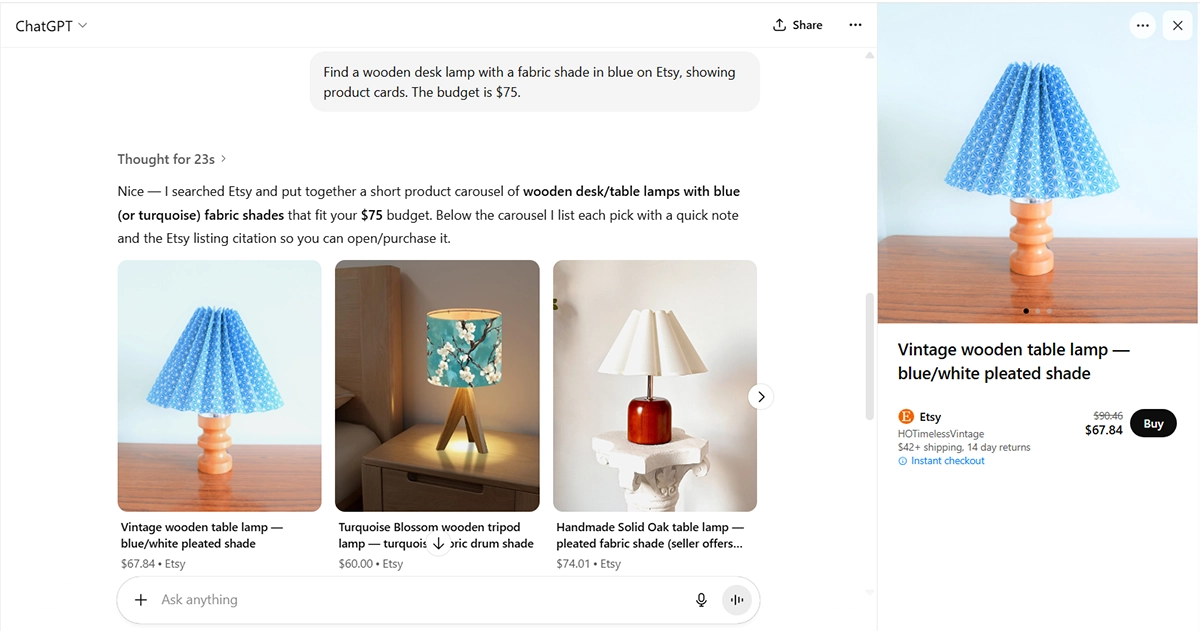
On September 29, 2025, OpenAI quietly dropped a game-changing update that could reshape how consumers discover and buy products online. ChatGPT (in partnership with Stripe) now supports in-chat product browsing and purchases — starting with Etsy and with Shopify “coming soon.”
Shoppers in the U.S. can see product cards, browse details, and complete a purchase without ever leaving ChatGPT. OpenAI also announced plans to open-source its Agentic Commerce Protocol, the backbone that enables these instant, AI-driven transactions.
What’s Happening
For now, only U.S. Etsy sellers are live, but Shopify integration is on the horizon.
- When users chat with ChatGPT about gift ideas or product categories (“show me handmade silver necklaces” or “I need a cozy fall sweater”), they’ll start seeing rich product cards with images, prices, and a buy button.
- Behind the scenes, the merchant can process the transaction through Stripe or handle the payment with another provider while still benefiting from Stripe’s risk scores for fraud protection.
- OpenAI’s new Product Feed Spec allows merchants to submit real-time data about product titles, pricing, inventory, and images.
- When Shopify joins, it will instantly put millions of merchants a single prompt away from purchase.
Why It Matters for Marketers
ChatGPT is no longer just an assistant; it’s a commerce surface. This change introduces a paradigm shift similar to what we saw when Google added Shopping Ads or when Amazon became the default search engine for product discovery.
But the biggest change isn’t volume — it’s intent. ChatGPT will likely drive fewer total visits to ecommerce sites, but the users who click through will arrive much closer to purchase stage. The AI assistant does the top-of-funnel sorting, surfacing only the most relevant options, complete with reviews and pricing.
For marketers, this means traditional SERP visibility and ad bidding strategies will need to evolve. ChatGPT compresses the journey between curiosity and checkout. The “search → click → browse → buy” funnel becomes “prompt → buy.”
How to Prepare for ChatGPT Instant Checkout
Even though the feature is still in early rollout, ecommerce marketers should act now to prepare. Here’s how:
1. Optimize Product Data for ChatGPT Commerce
AI agents can only recommend what they clearly understand. Clean, accurate, and structured product information will be your ticket into AI shopping ecosystems.
- Ensure your product schema (structured data) is valid, complete, and up to date.
- Include high-quality images, accurate prices, and real-time availability.
- Use clear, detailed titles and descriptions. LLMs reward precision and context.
If your ecommerce platform supports it, adopt OpenAI’s Product Feed Spec early; it mirrors many of the best practices used in Google Merchant Center, so implementation is pretty straightforward.
2. Monitor Analytics for ChatGPT Referrals
You may start seeing new referral sources (e.g., chat.openai.com or chatgpt.com) in your analytics. Tracking these early will help you measure the impact of AI-driven commerce on your funnel.
Start tracking metrics like:
- Sessions and conversions from ChatGPT referrals.
- Compare them against organic, paid, or social traffic.
- Compare them against organic, paid, or social traffic.
- Average order value (AOV) and conversion rate compared to organic or paid channels.
- Use these to identify whether ChatGPT shoppers are higher intent than traditional search visitors.
- Use these to identify whether ChatGPT shoppers are higher intent than traditional search visitors.
- Attribution overlap with branded search or shopping campaigns
- Understand where ChatGPT may influence or replace existing touchpoints.
- Understand where ChatGPT may influence or replace existing touchpoints.
Early visibility into ChatGPT referral traffic will help you gauge how high-intent ChatGPT shoppers behave versus typical search visitors. It will also help you evaluate whether this new AI commerce channel drives incremental sales or may cannibalize other performance channels.
3. Enable Instant Checkout via Agentic Commerce Protocol (ACP).
If you’re an Etsy seller or soon a Shopify merchant, explore enabling the Agentic Commerce Protocol for instant, in-chat checkout (you do not need to apply or build an integration, as you are already eligible). Reducing friction is everything — and this integration puts your product directly inside the conversation.
- If you’re already using Stripe, ACP integration can be as simple as a lightweight configuration.
- For non-Stripe merchants, review alternative ACP compliance paths to ensure you’re “agent-ready.”
4. Prioritize Products That Convert Well on Their Own
At launch, ChatGPT Instant Checkout only supports single-item transactions. Multi-item shopping carts aren’t available yet, so selecting the right products is critical. Here are some tips:
- Identify hero SKUs or best-sellers that consistently perform well without upsells.
- If you’re a merchant offering seasonal products, replenishable goods, or giftable items, prioritize these SKUs first. These are the purchases that shoppers are most likely to complete quickly through ChatGPT Instant Checkout.
- Optimize product data and images for these items first, ensuring they are “chat-ready” for AI recommendations.
Prioritize products that convert well on their own to maximize early returns from ChatGPT commerce while simultaneously preparing your catalog for multi-item checkout capabilities in the future.
5. Prepare for ChatGPT Ad Formats & Sponsored Placements
Once ChatGPT’s marketplace matures, expect sponsored listings or AI-curated placement options similar to Google Shopping or Amazon Ads. Being an early participant could help your products appear more prominently when consumers ask for recommendations.
Key Considerations for ChatGPT Instant Checkout
Most coverage so far has focused on the “wow factor” of buying inside ChatGPT. But to really prepare, marketers and merchants need to understand a few operational truths:
- Merchants remain the merchant of record.
OpenAI/Stripe enables the transaction, but you still own fulfillment, returns, and customer support.
- Fees apply per completed transaction
OpenAI will charge a “small fee” that appears in Shopify’s admin. Treat this like a new performance-based customer acquisition cost (CAC) and benchmark it against your paid search and social budgets.
- Product data quality is a competitive moat
It’s not just about clean titles. Semantic Product Optimization (making sure your product attributes, variants, categories, and metadata are structured in ways the AI can parse) will determine whether your products are even eligible for recommendation.
- Your brand still shows up at checkout
Customers see the merchant’s store name clearly displayed in-chat, which protects brand trust and long-term relationships.
The Bigger Picture
ChatGPT’s move into ecommerce isn’t just about convenience — it’s about owning intentful discovery. As conversational AI becomes a trusted shopping companion, the lines between search, recommendation, and transaction will blur.
For ecommerce marketers, this is both a challenge and an opportunity. You might see fewer clicks to your site, but those clicks — or purchases that happen directly in-chat — will come from users already primed to buy.
The smartest brands won’t wait for this to reach full rollout. They’ll treat ChatGPT as the next major channel in the performance-marketing mix, one that rewards structured data, trustworthy brands, and lightning-fast checkout.
Quick Checklist for Marketers & Merchants
Here’s a high-level prep list to act on now:
-
ACP AlignmentIf you use Stripe, you’re nearly agent-ready. Non-Stripe merchants need to evaluate ACP integration paths.
-
Data Hygiene AuditReal-time pricing, inventory, and variant sync. Eliminate gaps between what AI sees and what you actually sell.
-
Semantic OptimizationAdd clear product attributes, variant definitions, and metadata so AI can understand and recommend SKUs.
-
Prioritize Hero SKUsIdentify products that convert well on their own (gifts, replenishable goods, best-sellers).
-
Fulfillment & ReturnsPrepare for possible spikes in single-item orders. Returns may rise if impulse buying grows.
-
Benchmark Cost of AcquisitionCompare ChatGPT’s per-transaction fees with your existing acquisition costs to decide where to shift budget.